Sara Ludy
Lampo Performance Series
Nov 05, 2016
(8pm)
Performance
Please RSVP
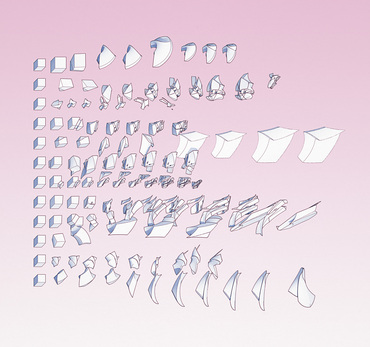
Sara Ludy premieres a new live audiovisual performance that arranges found imagery and field recordings into a rhythmic composition of otherworldly forms.
Ludy has worked with browsed images since 2000, generating works such as Low Prim and Postcards. More recently, she has collected pictures of natural disasters, tragedy and death, or what she calls “everyday horror.” In this special project, she alters these images until they become unrecognizable, blurring and shaping them into undulating 3D bodies and landscapes. Ludy also adds layered sound—manipulated recordings of AC hum and the buzz of traffic, trees, birds and insects captured from her workspace while browsing online. Tones rise and fall with the visual forms.
By combining materials from these dissimilar environments, and then filtering them through her inner world and intuitions, Ludy’s performance becomes an opportunity for the artist to expel the effects of image saturation through a meditative process.
Sara Ludy (b.1980, Orange, Calif.) is a Chicago-based artist whose practice investigates the confluence of the physical and virtual. Her practice incorporates photography, Second Life, animation, video, sound and live performance. Recent exhibitions include Museum of Contemporary Art Chicago, Chicago; bitforms gallery, New York; Postmasters Gallery, New York; Klaus von Nichtssagend, New York; Interstate Projects, Brooklyn; Eyebeam Center for Art and Technology, New York; Vancouver Art Gallery, Vancouver; Western Front, Vancouver; Kuenstlerhaus Bethanien, Berlin; Carroll Fletcher, London; Espace Verney-Carron, Lyon; and C-Space, Beijing.
This performance is presented in partnership with Lampo. Founded in 1997, Lampo is a non-profit organization for experimental music and intermedia projects. Support provided to Lampo by mediaThe foundation inc.
Image courtesy of Sara Ludy
The Graham would like to thank Perrier for supporting our public programs.

Ecologies of Power
Pierre Bélanger & Alexander Arroyo
Nov 05, 2016
(3pm)
Book Launch
Please RSVP
Join the Graham Foundation Bookshop for the launch of Ecologies of Power: Countermapping the Logistical Landscapes & Military Geographies of the U.S. Department of Defense (MIT Press, 2016), a Graham funded publication by Pierre Bélanger and Alexander Arroyo. Taking place as part of a new Saturday series of Graham Foundation grantee book launches in the Madlener House foyer, an informal space between the Graham Foundation’s Grantee Library and Bookshop, this event will feature a discussion between Bélanger and Arroyo as they introduce their anti-disciplinary process of research, development, and collaboration on the book during the past six years. The presentation will provide insight into the often neglected discourse about the role of media in spatial policy, logistical operations, military deployment, and infrastructural development at the intersection of matters of land, landscape, terrain, territory, and power. The talk will be followed by a reception in the bookshop where copies of the title will be available.
Weaving together an extraordinary range of visual media and original geographic work, this critical cartographic volume counter-maps the geospatial footprint of the U.S. Department of Defense beyond the battlefield, revealing a vast and shifting military-logistical landscape reshaping infrastructures and environments at every scale. Moving beyond conventional military geographies of combat zones and covert operations, Pierre Bélanger and Alexander Arroyo explore the forces and forms of this landscape from the molecular and metabolic to the political and the planetary, giving new dimension to familiar military milieux of land, air, sea, and space. In so doing, they trace out a growing assemblage of logistically linked “operational environments,” where militarized, demilitarized, and non-militarized landscapes are ever more entangled. It is in this assemblage that they find emergent ecologies of power at work in the making, unmaking, and remaking of operational environments across existing, emerging, and future horizons.
Pierre Bélanger is a landscape urbanist, founder of OPSYS (Landscape Infrastructure Lab), and Associate Professor of Landscape Architecture and Co-Director of the postgraduate Master’s Degree in Design Studies Program at Harvard University’s Graduate School of Design. Bélanger has received two Graham Foundation grants to individuals and is the national curator of the Canada Pavilion for the 2016 Venice Architecture Biennale.
Alexander Arroyo is an environmental designer and critical geographer with a background in philosophy from Columbia University and landscape architecture from Harvard University, currently pursuing his PhD in Geography at the University of California, Berkeley.
Related Graham supported projects:
2013 Individual Grant to Pierre Bélanger for “Ecologies of Power: Countermapping the Logistical Landscapes and Military Geographies of the U.S. Department of Defense"
2016 Individual Grant to Pierre Bélanger and Nina-Marie Lister for "Extraction Empire: Sourcing the Scales, Systems, and States of a Global Resource Empire"
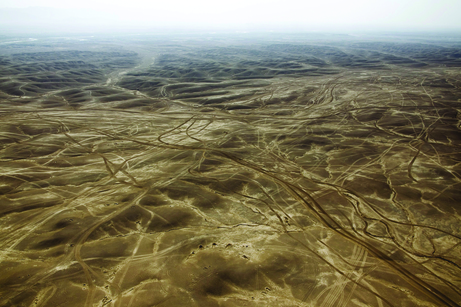
Image: Helmand Valley Region (Afghanistan) © Behrouz Mehri AFP Getty.
Yoshi Wada & Tashi Wada
Lampo Performance Series
Oct 22, 2016
(8pm)
Performance
Please RSVP
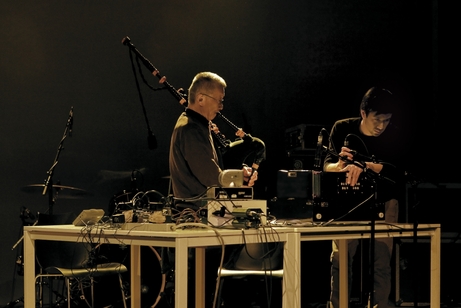
Composer, instrument builder and Fluxus artist Yoshi Wada and composer Tashi Wada make a rare Chicago appearance—Yoshi’s first since ’93 and Tashi’s local debut. The father-son duo presents an evening-length performance for Lampo based on a loose, ever-shifting structure with a newly modified setup of sirens, alarm bells, audio generators, bagpipes and organ.
Yoshi Wada (b.1943, Kyoto, Japan) is a composer and artist associated with the downtown New York experimental art scene of the last fifty years. He studied sculpture at the Kyoto University of Fine Arts, and then moved to New York in the late 1960s. Wada joined the Fluxus movement in 1968 after meeting its founder George Maciunas. In the early 1970s he began building homemade musical instruments and writing compositions for them based on his personal research in timbre, resonance and improvisation with the overtone series. He studied music composition with La Monte Young, North Indian singing with Pandit Pran Nath, and Scottish bagpipe with James McIntosh and Nancy Crutcher. Wada has presented his work at The Kitchen, New York; New Music in America, New York; Whitney Biennial, New York; Akademie der Kunste, Berlin; Emily Harvey Gallery, New York; Biennale of Sydney, Australia; Festival d’Automne, Paris; PS1, New York; Venice Biennale; and AV Festival, Newcastle, UK. His recorded works are published by Japanese record labels EM Records and Omega Point.
Tashi Wada (b.1982, New York, N.Y.) grew up in New York and lives in Los Angeles. His compositions use apparently simple structures and carefully calibrated tuning systems to generate rich and unanticipated perceptual effects. Wada presents his music often in collaboration with other artists including Charles Curtis and Stephan Mathieu, in addition to performing regularly with his father Yoshi Wada. He also runs Saltern, an imprint of Important Records, which he started in 2014.
This performance is presented in partnership with Lampo. Founded in 1997, Lampo is a non-profit organization for experimental music and intermedia projects.
The Graham would like to thank Perrier for supporting our public programs.
Joshua Simon, The Great Soviet Encyclopedia: Communism and the Dividual
Northwestern University Dept. of Art Theory & Practice VISITING ARTIST TALK
Oct 20, 2016
(7pm)
Talk
To watch recorded event
As part of our continuing collaboration with Northwestern University's Department of Art Theory and Practice, the Graham is pleased to host Joshua Simon, who will present The Kids Want Communism, a yearlong program of exhibitions marking 99 years since the October Revolution, which he initiated in collaboration with State of Concept Athens, Free/Slow University of Warsaw, Tranzit Prague, Skuc gallery in Ljubljana, the Visual Culture Research Center in Kiev, and MoBY-Museums of Bat Yam. The talk will outline how the communist horizon and real existing socialism can inform our understanding of the current social and cultural, political, and economic realities we are facing with the implosion of the neoliberal order. Simon's research in the past several years has been focused on notions of materiality and subjectivity, therefore, this talk will move between animism and productivism, commodity fetish and debt economy, double negation and metabolism, shock work and the dividual.
Joshua Simon is director and chief curator at MoBY-Museums of Bat Yam, as well as a co-founding editor of the Tel Aviv-Jaffa based Maayan publishing. He is the author of Neomaterialism (Sternberg Press, 2013), and editor of Ruti Sela: For The Record (Archive Books, 2015). Recent curatorial projects include: Factory Fetish at Westspace, Melbourne, co-curated with Liang Luscombe in 2015; Roee Rosen: Group Exhibition at the Tel Aviv Museum of Art, co-curated with Gilad Melzer in 2016; and The Kids Want Communism at MoBY in 2016. From 2011-2013, he was a Vera List Center for Art and Politics fellow.
This lecture is part of the Department of Art Theory and Practice at Northwestern University Visiting Artist Lecture Series, and is made possible with generous support from The Myers Foundations and the Jerrold Loebl Fund for the arts.
Image: El Lissitzky, Poster for the Russian Exhibition (Russische Ausstellung), Kunstgewerbemuseum Zürich, March 24- April 28, 1929.
The Graham would like to thank Perrier for supporting our public programs.
Prescriptions Issue 04 Release
Future Firm
Oct 08, 2016
(3pm)
Book Launch
Please RSVP
The Graham Foundation Bookshop is pleased to host the release of the fourth issue of Prescriptions, a quarterly zine edited by Ann Lui and Craig Reshke of Chicago-based architecture office Future Firm. The latest issue features a conversation with design technology specialist Andrew Heumann, focusing on the role of computation in professional and aesthetic practices.
To celebrate the release, join us for a reception and a discussion in the bookshop between Future Firm and Heumann. Past issues of the zine will be available for purchase alongside issue four, as well as a selection of related publications.
The title, Prescriptions, suggests that architectural practice may need some corrective medication. The zine features one interview per issue with builders of all kinds on their beginnings and futures. Topics in issue four include the emergence of a "coding class," democratic access to parametric design, C-3PO, computational camps and cultures, and the intersections of algorithms with governance.
Visit rx-mag.com to learn more about Prescriptions.
As a design technology specialist at Woods Bagot, Andrew Heumann develops custom tools and workflows for design teams across the firm. Formerly the leader of NBBJ’s design computation team, he has written more than fifteen plug-ins for 3D modeling tools (“Human,” the most popular, has had more than 20,000 downloads) and created many bespoke tools for design teams and practices, aiding in the management of project metrics, environmental and urban analysis, and façade design. Outside of his professional work, Heumann is a generative artist, working with data, algorithms, geometry, and pixels to create rich visual abstractions that engage and challenge the limits and affordances of digital media. He is trained in both architecture and computer science, and has lectured and taught seminars at Cornell University, Yale University, California College of the Arts, and the University of Washington. His work has been published in Wallpaper magazine, CLOG journal, and presented at conferences including ACADIA, SIMAUD, Autodesk University, and the AEC Technology Symposium.
Ann Lui is an assistant professor of architecture/interior architecture at the School of the Art Institute of Chicago. She holds an SMArchS from MIT in history, theory, and criticism and a BArch from Cornell University, where she was awarded the Charles Goodwin Sands Medal and the Clifton Beckwith Brown Memorial Medal. Previously, she practiced at SOM, Ann Beha Architects, and Morphosis. Lui was assistant editor of OfficeUS Atlas (2015) and coeditor of Thresholds, "Scandalous" (2015).
Craig Reschke is an architect interested in landscape practices. He is a registered architect in the state of Illinois. He graduated from Harvard's Graduate School of Design, where his research focused on rural American landscapes, and he graduated with the Jacob Weidenmann Prize. He also holds a BArch from the University of Tennessee. Previously, Reschke was a project architect at SOM and RODE Architects, where he led the design of buildings at many scales.
Future Firm is a Chicago-based architecture office interested in the intersections between landscape territories and architectural spectacle. Recent research explores the relationship between finance, economy, and the built environment.



 PREVIOUS POSTS