2026
-
upcoming events
-
past events

Madlener House
4 West Burton Place
Chicago, Illinois 60610
Telephone: 312.787.4071
info@grahamfoundation.org
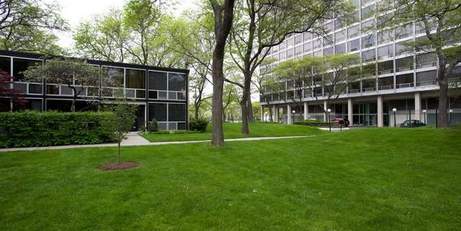
Many architectural publications glorify iconic architecture through photographs of buildings taken from the outside or through images of sparsely furnished interiors devoid of people. Thanks for the View, Mr. Mies shows life in Lafayette Park—a collection of residential buildings designed by Mies van der Rohe in downtown Detroit—from the inside out and documents the point of view of its homeowners, tenants, and staff.
Graphic designers and co-editors, Danielle Aubert and Natasha Chandani, will speak about the new book, and contributor Noah Resnick will talk about the design and operation of the buildings’ grounds, designed by landscape architect Alfred Caldwell, from his perspective as a Lafayette Park resident.
Danielle Aubert is a professor of graphic design at Wayne State University in Detroit. In 2008 she collaborated with Lana Cavar on the design for the book ReFusing Fashion: Rei Kawakubo for the Museum of Contemporary Art Detroit. More recently, she collaborated with Dutch designers Mevis and van Deursen on MEC (Steidl Press, 2010) about the work of artist Mary Ellen Carroll. Her work has appeared in various exhibitions and design publications, including Wired and Metropolis magazines. Her book 16 Months Worth of Drawing Exercises in Microsoft Excel was published in 2006 by Various Projects. Danielle holds a BA in English Literature from the University of Virginia and an MFA in graphic design from Yale University.
Natasha Chandani is based in New York City. She has worked on a number of publications with clients in the United States, the Netherlands, the UK and India. For several years she worked as a designer for the architecture publication Volume. She collaborated with Dutch designer Irma Boom on the design of Al Manakh (with editors Rem Koolhaas, Ole Bouman and Mark Wigley), a study of the current condition of the Gulf for the International Design Forum in Dubai, 2007. She most recently worked on American Craft magazine.
Noah Resnick currently teaches and practices in Detroit. He is the director of graduate architecture at the University of Detroit Mercy and a founding principal of uRbanDetail, an intimate research-based architecture and urban design studio that operates under the interrelated concepts of the architectonics of multiple scales; the architect as urban collaborator; and the architect as community builder. Noah earned his BArch from the Illinois Institute of Technology in Chicago and completed his Masters of Science in Architecture Studies at the Massachusetts Institute of Technology.
Thanks for the View, Mr. Mies is co-edited by Danielle Aubert, Lana Cavar, Natasha Chandani and published by Metropolis Books, 2012.

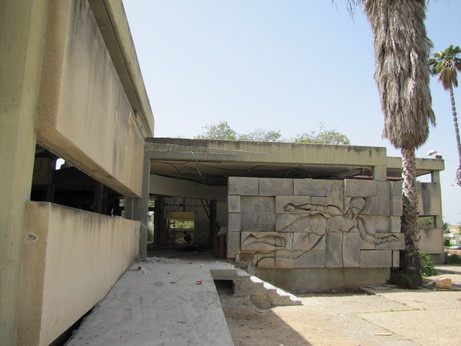
Semi-demolished dinning hall at Yad Hanna. (Photo: Yuval Yasky, 2010
Yuval Yasky, head of the architecture department at the Bezalel Academy of Art and Design in Jerusalem, will speak about his ongoing research on the Kibbutz movement in Israel. The lecture will present the evolution of the Kibbutz from its early days and the current struggle to preserve its unique qualities amidst processes of change and privatization.
Yuval Yasky (b. 1970, Tel Aviv, Israel) is a practicing architect based in Tel Aviv. He studied Philosophy and Art History at Tel Aviv University and Architecture at the Southern California Institute of Architecture. He has taught at the Technion in Haifa and Bezalel Academy of Art and Design in Jerusalem where he is the head of the Architecture Department. He was the curator of numerous exhibitions among them - the Israeli pavilion at the 12th Venice Architecture Biennale titled Kibbutz: An Architecture without Precedents (2010), Kibbutz and Bauhaus – Pioneers of the Collective (the Bauhaus Foundation, Dessau, 2011), Architecture for the Community (Urban Center, Milan, 2011).
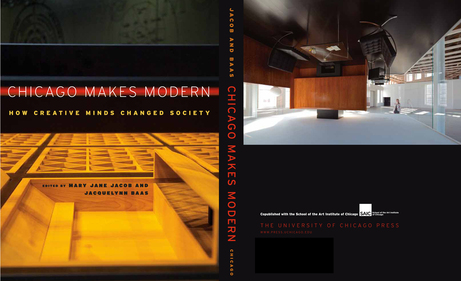
Cover of Chicago Makes Modern: How Creative Minds Changed Society, featuring Ângela Ferreira’s Crown Hall/Dragon House, 2009, as shown in the exhibition “Learning Modern” at the School of the Art Institute of Chicago’s Sullivan Galleries. Photo: Jill Frank.
From the radical social and artistic perspectives implemented by Jane Addams, John Dewey, and Buckminster Fuller to the avant-garde designs of László Moholy-Nagy and Mies van der Rohe, the prodigious offerings of Chicago's modern minds left an indelible legacy for future generations. Staging the city as a laboratory for some of our most heralded cultural experiments, Chicago Makes Modern: How Creative Minds Changed Society reimagines the modern as a space of self-realization and social progress—where individual visions triggered profound change. Featuring contributions from an acclaimed roster of contemporary artists, critics, and scholars, this book demonstrates how and why the Windy City continues to drive the modern world.
At this book launch event, contributor Ben Nicholson and artist Iñigo Manglano-Ovalle remark on their work presented in this publication, reflecting on their personal artistic and scholarly research and the continuing legacy of modernism in Chicago and beyond.The talks will be followed by a reception in the Madlener House library where signed copies of the publications will be for sale.
Ben Nicholson is associate professor in the Department of Architecture, Interior Architecture, and Designed Objects at the School of the Art Institute of Chicago. He taught at the Illinois Institute of Technology for sixteen years before joining the faculty of SAIC in 2006. He has been a visiting professor at the Southern California Institute of Architecture, the Royal Danish Academy, the University of Edinburgh, and the University of Houston. He was a fellow at the Chicago Institute for Architecture and Urbanism and has received grants from the Graham Foundation and others. His work alternates between designing homes and urban projects, digging into vernacular culture, and studying geometry and pattern. Nicholson’s earlier work focused on issues of domestic architecture, resulting in the publications Appliance House (MIT Press, 1989) and Thinking the Unthinkable House (Renaissance Society, University of Chicago, 1997). He is currently coediting a book about Frederick Kiesler and Paul Tillich titled Forms of Spirituality: Modern Architecture and Landscape in New Harmony. Nicholson is also creating micro-infrastructural projects in the utopian town of New Harmony, Indiana, where he lives.
Iñigo Manglano-Ovalle (b. 1961, Madrid, Spain) received a B.A. from Williams College in Williamstown, MA, and an M.F.A. from The School of The Art Institute of Chicago. His noted film trilogy Le Baiser/The Kiss (1999), Climate (2000), and In Ordinary Time (2001) focuses on the architecture of Mies van der Rohe and the implications of Modernism. Solo exhibitions include: The Art Institute of Chicago; The Krefeld Suite, Museum Haus Esters and Haus Lange, Krefend, Germany; El Museo de Arte Contemporáneo de Monterrey and Museo Tamayo Arte Contemporaneo, Mexico City; Barcelona Pavilion, Fundación Mies van der Rohe, Barcelona, Spain; and Museum of Contemporary Art, Chicago, among others. Group exhibitions include: Bienal de São Paulo, São Paulo, Brazil; InSITE, San Diego; Tempo, Museum of Modern Art, New York; Moving Pictures, Solomon R. Guggenheim Museum, New York and Guggenheim Museum, Bilbao, Spain; The Whitney Biennial, Whitney Museum of American Art, New York; Liverpool Biennial, Liverpool, England, and Documenta 12, Kassel, Germany. He has received a National Endowment for the Arts fellowship, the Media Arts Award from the Wexner Center for the Arts, the John D. and Catherine T. MacArthur Foundation Fellowship, and a John Simon Guggenheim Foundation Fellowship.
Chicago Makes Modern was supported by a grant from the Graham Foundation in 2010. The book is a co-publication of the School of the Art Institute of Chicago and the University of Chicago Press, with special thanks to the Mies van der Rohe Society at the Illinois Institute of Technology, and the Loyola University Museum of Art. This launch event is also made possible by the Consulate General of Switzerland.
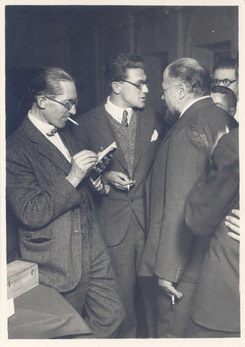
Le Corbusier, Andrei Burov, and Alexander Vesnin in Moscow in 1928, © Le Corbusier Foundation Paris.
The extraordinary explosion that reshaped Russian culture between the October 1917 revolution and the Stalinist freeze of 1930 induced extreme effects on architecture. Rationalist and constructivist designers imagined a new urban environment in which striking monumental structures conveyed the dynamics of the revolution, while several dozen edifices responded to emerging, innovative practices in the realm of housing and leisure.
In permanent contact with Western scenes such as Germany, France, and North America, albeit indirectly, the architects of the competing Avant-Garde groups saw their dreams crushed by the dire reality of rudimentary building technologies and the conservatism of the emerging ruling class. Yet this pattern of explicit, and sometimes veiled, exchange continued to characterize the production of architecture until the final victory of Modernism in the mid-1950s.
Jean-Louis Cohen was born in 1949 in Paris. Trained as an architect, he received a PhD in history. Since 1993, he has held the Sheldon H. Solow Chair for the History of Architecture at New York University's Institute of Fine Arts. His research activity focuses on twentieth-century architecture and urban design. From 1997 to 2003, he imagined and developed the Cité de l'architecture for the French Minister of Culture, a museum, research, and exhibition center that opened in 2007. In 2012, he received a Graham Foundation grant for his upcoming publication Modern Architectures in History: France (Reaktion Books). A curator of numerous exhibitions in Europe and North America, his books include Le Corbusier and the Mystique of the USSR (1992), Scenes of the World to Come (1995), Casablanca, Colonial Myths, and Architectural Ventures (2002, with Monique Eleb), Mies van der Rohe (2007), Architecture in Uniform (2011), and The Future of Architecture. Since 1889. (2012).
Modern Architectures in History: France
http://grahamfoundation.org/grantees/4817-modern-architectures-in-history-france
Architecture in Uniform: Designing and Building for the Second World War
http://grahamfoundation.org/grantees/3677-architecture-in-uniform-designing-and-building-for-the-second-world-war
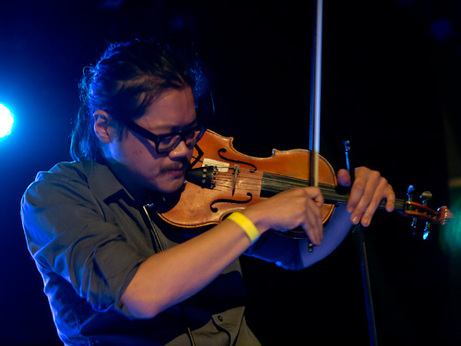
Lampo and the Graham Foundation are pleased to present Spencer Yeh in his third Lampo performance featuring new and recent videos including Baby Birds, Eclipse, Scrub Study, and a single-channel composite of the multi-channel installation, IMVIS. According to Yeh, “What I'm presenting is essentially a live performance with video acting not only as a supplement, but as a rudimentary AI [artificial intelligence]-type presence in live improvisation…In generating both pre-determined, as well as indeterminate gestures, the videos act as a ‘score’ as well as a sparring partner. The audio feed is placed on level aural ground with the musician's signal.”
Spencer Yeh (B. 1975, Taipei, Taiwan), studied film at Northwestern University, lived in Cincinnati for many years, and is now based in Brooklyn. He is recognized for the musical project Burning Star Core, as well as many other individual and collaborative activities. Current projects include The New Monuments (with Ben Hall and Don Dietrich), a yet-to-be-named quartet with Nate Wooley, Ryan Sawyer, and Colin Stetson, and ongoing collaborations with Okkyung Lee, Graham Lambkin, John Wiese, Chris Corsano, Paul Flaherty, Lasse Marhaug, Eli Keszler, and many others.
This performance is presented in partnership with Lampo. Founded in 1997, Lampo is a non-profit organization for experimental music, sound art and intermedia projects.
GALLERY AND BOOKSHOP HOURS
Wednesday–Saturday, 12–5 p.m.
Free admission, no reservations required
CONTACT
312.787.4071
info@grahamfoundation.org
Copyright © 2008–2026 Graham Foundation. All rights reserved.
 PREVIOUS POSTS